If you’ve been working on your website for some time, you already know that Google rankings are no longer just about keywords and backlinks. While those factors still matter, modern SEO goes much deeper. Google quietly observes how real users behave on your site, how smoothly they read your content, and whether they feel comfortable staying on your pages.
One important but often overlooked factor is dwell-speed.
Table of Contents
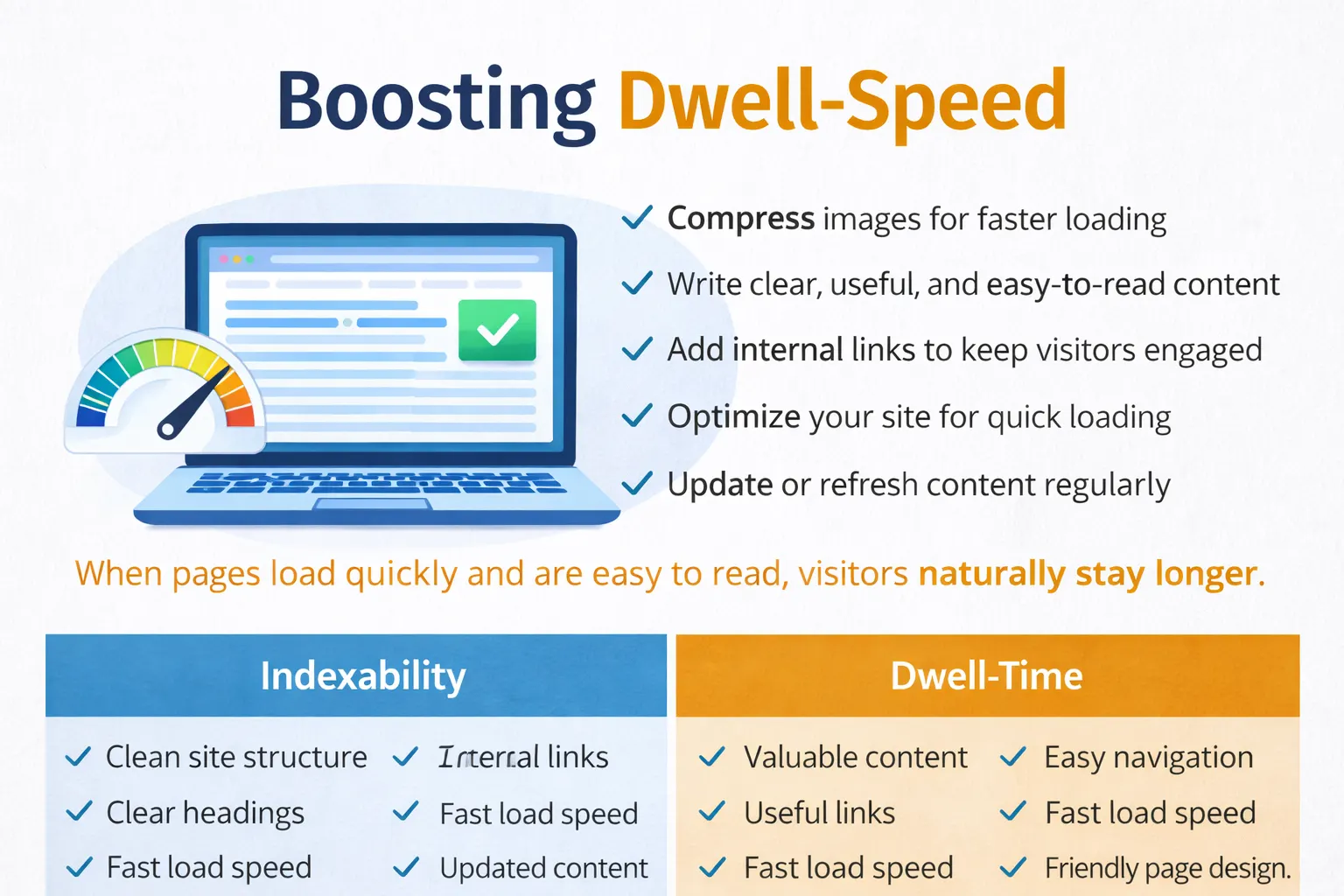
In simple terms, dwell-speed refers to how quickly users can start reading your content and how comfortably they continue interacting with it. It includes page load speed, layout clarity, readability, and overall user experience. When visitors stay longer, scroll naturally, and engage with your content, Google sees your page as helpful and relevant.
That’s why boosting dwell-speed has become essential for better indexing and stronger search visibility. In this article, we’ll explore practical ways to improve dwell-speed, increase dwell time, and make your website easier for Google to crawl and understand—without making complicated technical changes.
What Is Dwell-Speed and Why Does It Matter?
Dwell-speed is not an official Google metric, but it’s closely connected to user behavior signals such as:
- Time spent on page
- Scroll depth
- Interaction with internal links
- Bounce behavior
- Page load speed
When users land on a page and immediately leave, it sends a negative signal. But when they stay, read, and interact, Google interprets that as a positive experience.
Boosting dwell-speed helps because:
- Users can access content faster
- Reading feels smooth and stress-free
- Pages feel organized and trustworthy
- Google crawlers detect positive engagement
In short, better dwell-speed leads to better indexing and stronger SEO performance.
How Do I Improve My Site’s Indexability?
Site Indexability means how easily Google can find, crawl, understand, Improve Page Rank Through SEO, and store your content. Even high-quality content won’t rank if Google struggles to index it properly.
Here are simple but effective ways to improve indexability:
- Keep your website structure clean and logical
- Ensure important pages are reachable within a few clicks
- Use internal links to guide crawlers
- Avoid broken links and unnecessary redirects
- Keep URLs simple and readable
- Update older content regularly
When your site is easy to crawl, Google bots move faster and index pages more efficiently. And when indexing improves, boosting dwell-speed becomes easier, because users can load and navigate your content without friction.
Relationship Between Indexability and Dwell-Speed
Indexability and dwell-speed work together. One supports the other.
| Factor | Impact on Indexing | Impact on Dwell-Speed |
|---|---|---|
| Clean site structure | Faster crawling | Easier navigation |
| Internal linking | Better page discovery | Longer user sessions |
| Fast page load | Faster indexing | Lower bounce rate |
| Updated content | More frequent crawling | Higher engagement |
| Clear formatting | Better understanding | Comfortable reading |
When both are optimized, Google receives strong signals that your website deserves better visibility.
How Does Dwell Time Affect Website SEO?
Dwell time refers to how long a visitor stays on your page before returning to search results. While Google doesn’t publicly confirm using dwell time directly, user behavior strongly influences rankings.
Here’s how dwell time affects SEO:
- It shows that your content matches search intent
- It signals value and usefulness
- It indicates user satisfaction
- It supports trust and authority
- It helps Google refine ranking decisions
When users stay longer, Google assumes your page answered their question. That’s why boosting dwell-speed naturally increases dwell time, because users don’t feel delayed, confused, or overwhelmed.
What is 3 c’s Concept ?
To understand dwell-speed and indexability clearly, it helps to revisit the 3 C’s of SEO.
1. Content
Your content should be:
- Clear and easy to understand
- Written in simple language
- Structured logically
- Focused on solving real problems
Good content keeps users reading, which directly improves dwell time.
2. Code
Code includes everything technical, such as:
- Page speed
- Mobile responsiveness
- Clean HTML structure
- Proper meta tags
- Crawlable links
Clean code ensures fast loading and smooth crawling.
3. Credibility
Credibility is built through:
- Internal and external links
- User engagement signals
- Low bounce rate
- Consistent content updates
When people stay longer and interact naturally, credibility grows over time.
Boosting dwell-speed touches all three C’s without forcing artificial SEO tricks.
Boosting Speed and Page Load Time: Best Practices
Page speed plays a huge role in dwell-speed. If a page takes too long to load, users leave before reading even one line.
Here are practical page load improvement steps:
- Compress images without losing quality
- Use lightweight themes
- Remove unused plugins and scripts
- Enable browser caching
- Minimize CSS and JavaScript files
- Choose a reliable hosting provider
Even small improvements can significantly reduce load time and increase engagement.
Common Page Speed Factors That Affect Dwell-Speed
| Page Speed Factor | Effect on Users | SEO Impact |
|---|---|---|
| Large images | Slow loading | Higher bounce rate |
| Too many scripts | Delayed interaction | Poor user signals |
| Slow server | Long wait time | Lower crawl efficiency |
| Heavy themes | Laggy experience | Reduced dwell time |
| No caching | Repeated load delay | Lower engagement |
Improving these areas makes reading feel instant and effortless.
How to Boost Dwell Time Naturally (Without Tricks)
Boosting dwell time doesn’t require manipulation. It’s about making users feel comfortable.
Here’s a natural and effective approach:
- Use short paragraphs for easy scanning
- Add clear subheadings to guide readers
- Break long sections into digestible parts
- Use internal links where they add value
- Answer questions directly
- Avoid unnecessary filler content
- Maintain a friendly, conversational tone
When content flows naturally, users stay without realizing it. This organic engagement is exactly what Google values.
Why Boosting Dwell-Speed Helps Long-Term SEO
Short-term SEO tricks may give quick results, but they don’t last. Boosting dwell-speed focuses on long-term quality.
Long-term benefits include:
- Faster and more consistent indexing
- Improved rankings over time
- Better performance in Google Discover
- Higher trust from users
- Stronger site authority
Instead of chasing algorithms, you’re improving real user experience.
Final Thoughts
Dwell-speed may sound technical, but at its core, it’s about respecting the reader’s time. When your pages load quickly, your layout feels clean, and your content is easy to follow, people naturally stay longer.
And when people stay longer, Google notices.
By improving indexability, page speed, and content flow, you create a website that both users and search engines appreciate. That’s the real foundation of sustainable SEO.